The Lowther Journal · 14 November 2026
Voigt and the Interview That Never Happened
A collection of history from letters Paul Voigt wrote and other archival sources.
Peter Snell
Lowther Loudspeakers · 13 min read
When Bruce Edgar approached Paul Voigt about an interview in 1980, Voigt initially declined. He was in his late seventies and still had too many projects and immediate worries to make time for it.
Eventually, he agreed. But illness postponed their plans. While awaiting surgery in January 1981, Voigt typed long letters answering Edgar’s questions, recalling the experiments, setbacks and discoveries of his working life.
Those letters allow us to follow much of what happened in Voigt’s own words (until John Howes’s book on the man himself is released anyway), supported by the documents and contemporary reports his work left behind. [2]
The history of Lowther and hi-fi is very much entangled with Voigt’s work, his principles guiding most of what we still do to this day. They are what make Lowther so unique in the hi-fi industry and indeed why our speakers are so revered across the world.
This week I’ve tried to piece together a short bit of narrative based on interviews, papers and stories we have found in the Lowther archive through the years.
Grab a cuppa and I hope you enjoy.
Cathedrals, 4ft Mouths and Monsters
In 1924, Paul Voigt’s laboratory had a cathedral ceiling. Beneath it, he raised a horn with a mouth four feet square, a throat four inches square and a length of about five feet. It had what he called a “monster” magnet. Thanks to the room’s previous occupants (who had repaired radio sets there) there was a contraption that allowed him to lift the loudspeaker until its axis was about nine feet above the floor. [1]
Voigt often worked late into the evenings. Through the magic of the BBC, he would play live performances from London’s leading hotels into his lab. He listened through the four-foot horn until the broadcasts ended at midnight.
“It provided the most perfect reproduced sound I had yet heard up to that time.”
This is where our story begins. With a man trying to reproduce music as faithfully as he could. The four-foot horn beneath that cathedral ceiling was a result of a pursuit that would help set the stage for what hi-fi would become, and eventually Lowther.
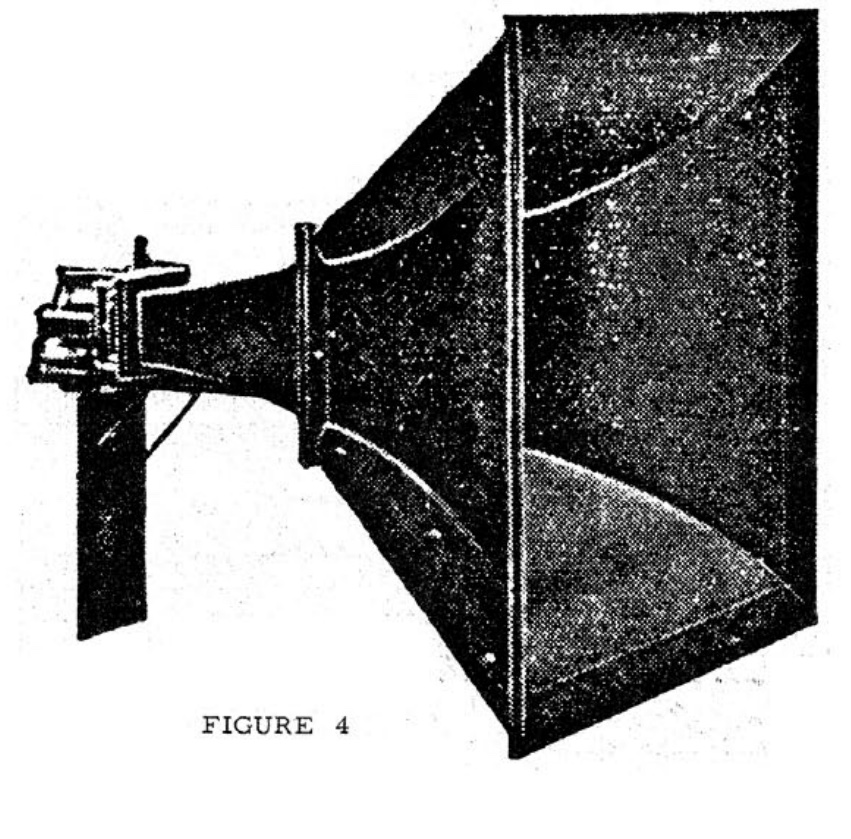
Voigt’s large tractrix horn, reproduced as Figure 4 in the interview. Source PDF page 7, Figure 4.
The Bell Before the Horn
Voigt had joined the Edison Bell works in 1922, the year he graduated in electrical engineering from University College London. Born in London in 1901, he had been learning engineering at Dulwich College since he was thirteen. His first Wireless World article appeared while he was still a student. [4]
Edison Bell made gramophone records. A bit like modern day streaming vs physical discs and records today, the company feared broadcasting would damage its market. So Bell hired Voigt to help establish its radio business. He accepted the job on a condition: his inventions would remain his property. He would pay for the patents; Edison Bell would have preferential licensing rights.
“There never was a better incentive to invent things of direct use to the company.”
Alongside his work on radios and test equipment, Voigt turned his attention to Edison Bell’s recording methods. The BBC was already capturing performances with microphones for broadcast. He recognised that the same electrical approach could help the company make better records.
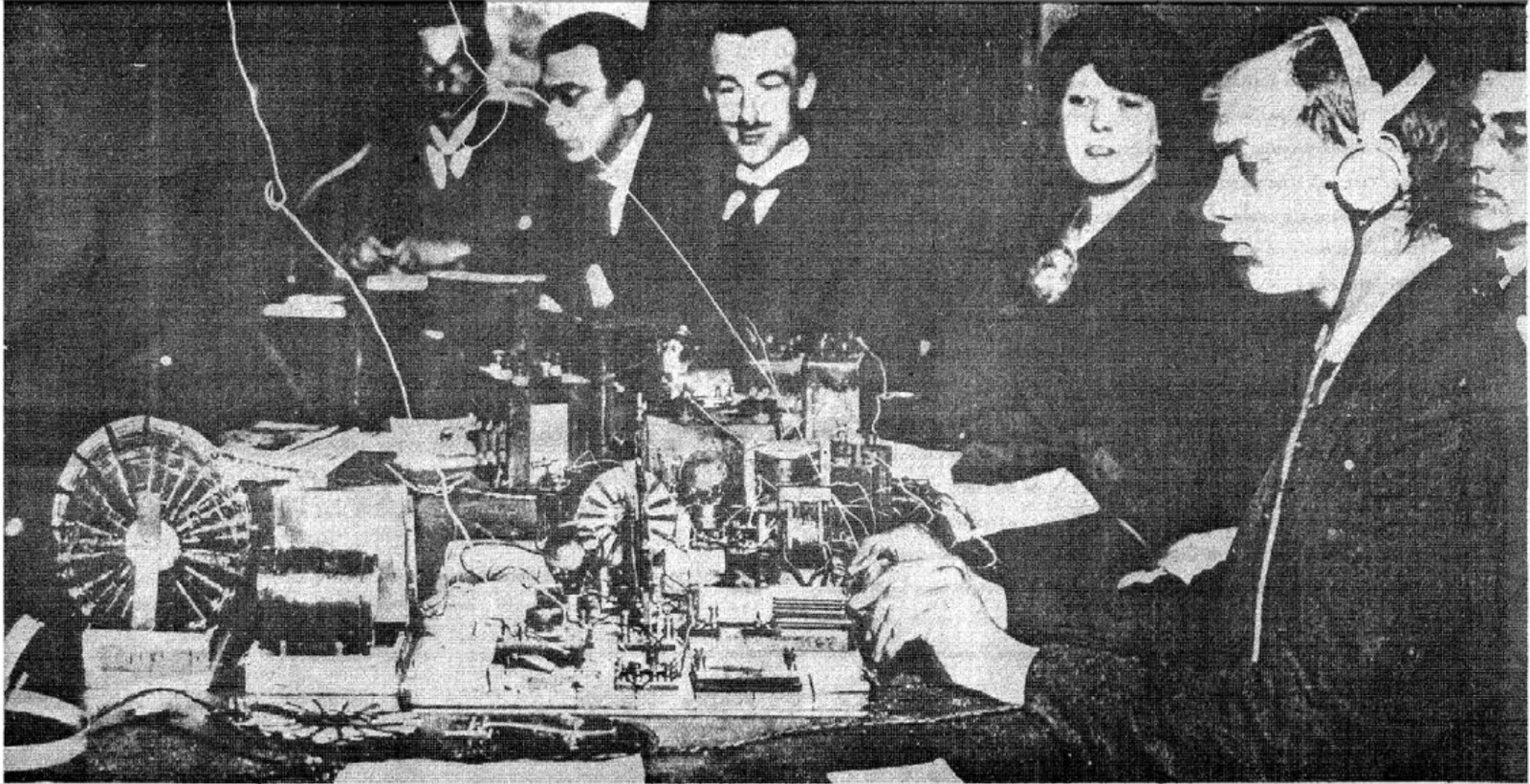
Paul Voigt, wearing headphones at the right, demonstrating an amplifier circuit in Peckham in 1922. Source PDF page 1, Figure 1.
Voigt began experimenting with microphones and developing his own moving-coil cutter. His aim was to capture the performance as an electrical signal, amplify it and use that signal to drive the cutting mechanism.
He began by experimenting with equipment he already had. He used a loudspeaker backwards as a microphone in the studio, connected to another loudspeaker in his laboratory. He also tried carbon microphones, but rejected them because they distorted the sound.
Then he designed his own microphone. Its moving surface was a very thin, saucer-shaped aluminium diaphragm, suspended on threads... Sound made it vibrate, moving a coil in a magnetic field and generating an electrical signal. He wanted that diaphragm to respond freely to the sound, with very little mechanical restraint.
By the end of 1926, his electrical recording system was in commercial use at Edison Bell. The engineer hired to help the company respond to radio was now changing how it made its records. [4]
Yet making a recording created a new problem he needed to solve. The musicians needed to judge what they had recorded, and the gramophones available to them were a terrible playback system that would leave a lot of time being wasted in the studio. [5]
The Hole in the Wall
Voigt wanted a loudspeaker good enough to use as a reference. Before deciding how to build it, he considered what successful reproduction ought to sound like.
In 1924, during a discussion following a lecture by the BBC’s chief engineer, he described his “hole in the wall” theory. Imagine someone speaking to you through an opening from another room. The voice reaches you and you get a sense of the space on the other side.
On a side note, years later, a visitor listening to one of his Domestic Corner Horns described the experience as hearing through a window (achievement unlocked!). His work on microphones and recording cutters had given Voigt experience with moving coils. He now applied that knowledge to a loudspeaker. The company blacksmith supplied a U-shaped iron core using a coil in a strong magnetic field to drive a lightweight diaphragm. [3]
This early diaphragm was shaped like a shallow saucer, with aluminium spokes transmitting the movement of the coil. The difficulty lay in attaching those spokes securely. When the adhesive joints failed, the assembly rattled.
Voigt would have to carefully repair it every time, get everything working and turn up the volume. Within five minutes, he recalled, the rattle could be back.
Another issue he discovered was acoustic. “I had never had anything sounding so ‘tinny’. The highs were strong and the lows very poor.”
The missing bass forced him back to his calculations. At low frequencies, air could escape sideways from in front of the diaphragm instead of providing the resistance he had assumed. He needed to contain that movement, then let the sound expand gradually into the room. A straight pipe moved the abrupt transition to its far end. He began working out a horn whose sides would flare more rapidly as they approached the mouth. [6]
He drew the curve with a ruler. Only afterwards did a company draftsman tell him its name: a tractrix. Voigt filed his horn patent on 5 July 1926. It was published in October 1927.
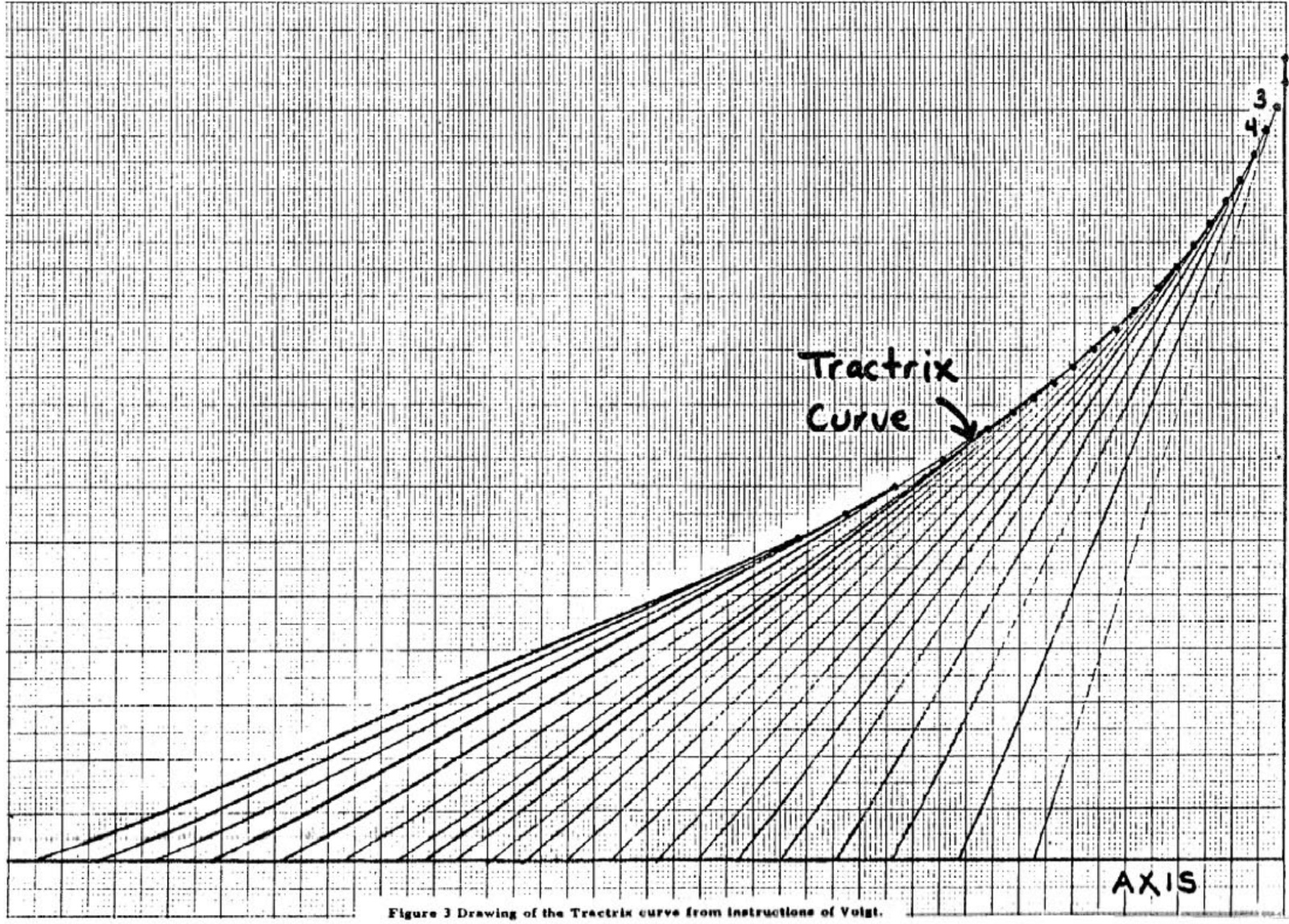
The tractrix curve, drawn from Voigt’s instructions. Source PDF page 6, Figure 3.
Then came the time to translate the drawing into plywood. The horn was designed as four flared sections bolted together. Along the length of the horn the angle between the panels would change, making it pretty complex to construct. So Voigt designed a jig to make the cutting easier. [7] This caused a dispute with the company carpenter who insisted the angle was plainly 45 degrees and, as Voigt remembered it, saw no need for the jig.
“Well, when people know all the answers I do not waste time arguing with them.”
The carpenter had an awful job making the sections fit…
The completed four-foot horn gave Voigt what he had been missing. He reported response below 100 Hz, still useful at 50 Hz, and the tinny sound had gone. In the cathedral-ceiling laboratory, with the horn raised above him, he could spend his late working evenings listening to those live BBC broadcasts. [1] This was the 4ft Voigt Horn.
The 4ft Voigt Horn was developed further. The Lowther Voigt Museum records a version with a bass chamber to extend its low-frequency response. A four-foot example described in Hi-Fi World in 1994 had a forward-firing bass tunnel beneath the main horn. John Howes recovered it after hearing that horns in a dance hall were about to be discarded. [8]
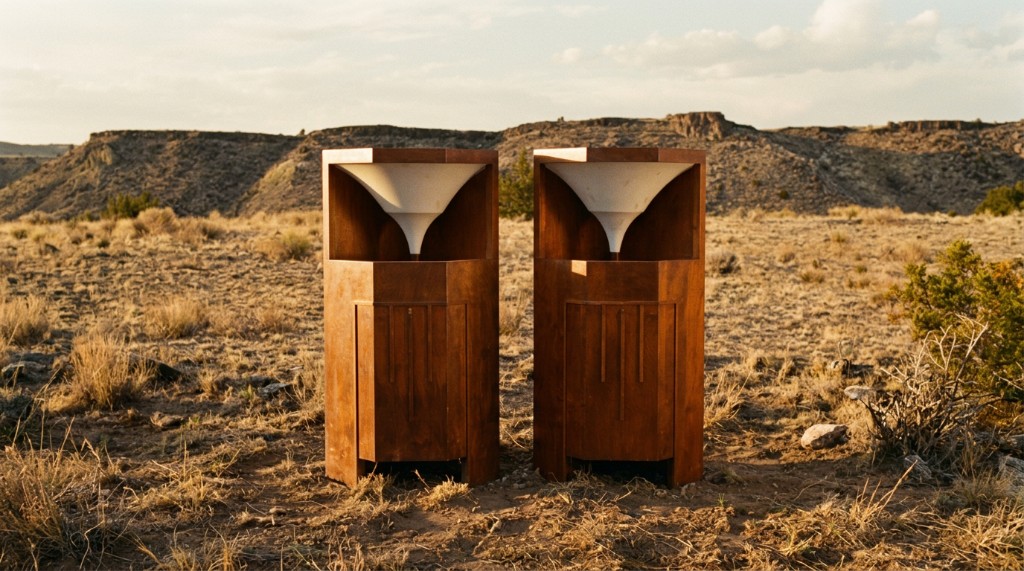
Lowther’s present-day four-foot Voigt Horn includes an additional bass horn, continuing that development. [9]
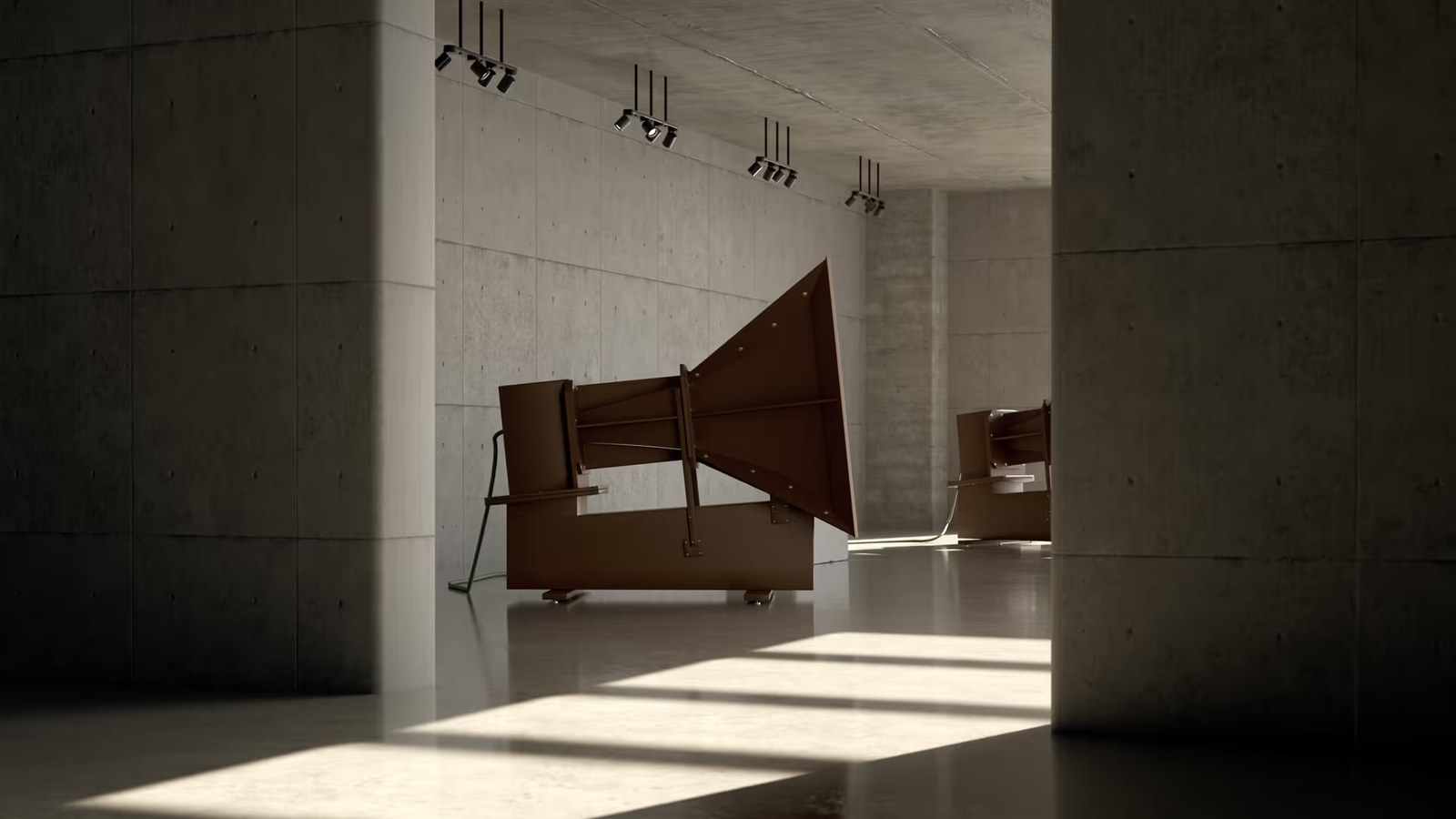
Lowther’s present-day four-foot Voigt Horn.
Edison Bell failed in April 1933. Voigt started his own business to keep the loudspeaker work going.
Lowther-Voigt
At RadiOlympia the following year, he met O. P. Lowther, whose ambition was to make the best radiogramophone he could. Lowther at the time made the tuners and amplifiers. Voigt supplied the speakers. Their alliance produced the Lowther-Voigt Radiogram. [10]
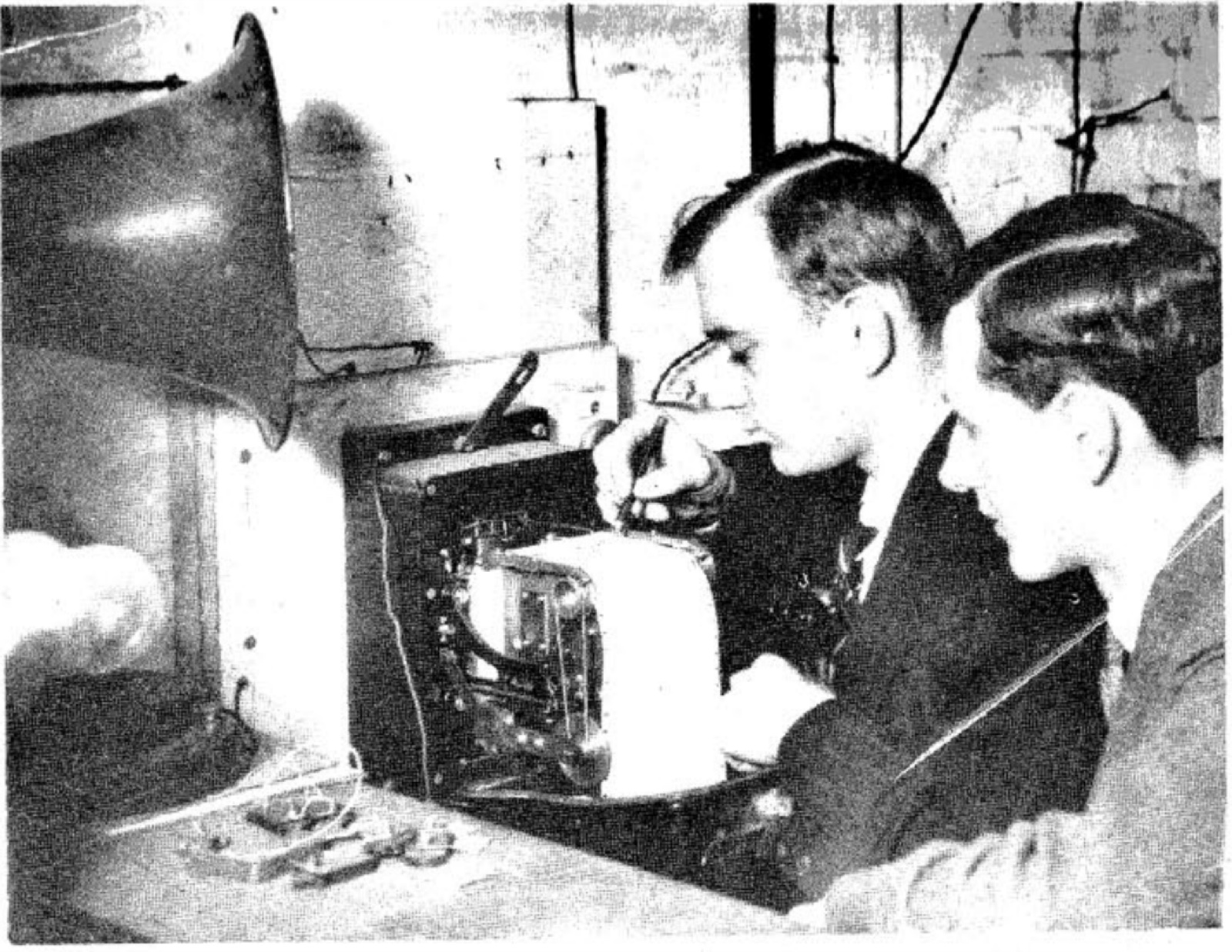
Voigt, at the left, taking a response curve at Voigt Patents. Source PDF page 8, Figure 5.
During this time Voigt also developed the Domestic Corner Horn, using a corner of the room as part of the acoustic arrangement. Its reflector spread sound towards people sitting or standing. Below it, a folded, tapered passage helped extend the bass from a relatively small cone. [11]
People could finally hear the results in their own homes. Advertisements from that time invited hosts to accommodate an engineer overnight and gather about six visitors for a demonstration. They could bring their records, compare equipment and listen for themselves.
On Coils and War
In 1933, Voigt had found another way to improve the treble: a smaller cone within the main diaphragm. This twin-cone arrangement helped the loudspeaker reproduce higher frequencies and became one of his most widely adopted inventions. Wharfedale and Goodmans both licensed the patent.
But there was more to gain from the assembly that moved those cones.
During a long drive to Scotland in the late 1930s, Voigt began working through a further change to his loudspeaker. He had read that the speech coil should weigh as much as the diaphragm it drove. He wondered what he could gain by making it lighter.
Removing layers of wire would reduce the weight of the moving assembly. It would also allow him to narrow the magnetic gap, increasing the field strength around the coil. He worked through the competing effects as he drove. Laboratory measurements later confirmed the increase in field strength.
He called the design the Light Coil Twin. It received a favourable review in Wireless World in March 1939. [13]
Alongside that work, Voigt was experimenting with permanent magnets to replace the electromagnets that required their own electrical supply. He hoped to demonstrate a new unit during the 1939 radio exhibition, but it arrived so late that it was delivered directly to the premises he and Lowther had rented near Olympia.
He compared it with one of his existing electrically energised speakers. The new unit sounded worse. Despite the rush to get it there, he removed it from view. [14]
Then Britain declared war. On the Monday after the announcement, the exhibition was being dismantled. Sales collapsed. He stopped his tone-burst tests because he feared the sounds might be mistaken for enemy activity.
Ida did the drafting and office work while they kept the business alive by maintaining cinema horns.
Post-war Magnetism
After the war, improved magnetic materials gave Voigt another chance to develop the permanent-magnet loudspeaker.
Donald Chave, formerly Lowther’s chief technician and now its owner, was pursuing the same goal. Voigt suggested that they work independently and hold back from comparing notes until their designs were complete. Voigt placed the magnetic material inside the assembly. Chave developed a design with the magnetic material outside it.
Voigt’s unit received a favourable report in Wireless World in March 1949. [15] Chave’s experiments produced the much revered Lowther PM series, combining his permanent-magnet system with Voigt’s twin-cone diaphragms. Voigt was clear about the credit each deserved regarding the PM series. His diaphragm work was part of the PM2, but the transition to the Lowther permanent-magnet system was Chave’s achievement.
“His work has merit,” he wrote, “and it would not be proper for me to accept all the credit.”
Their relationship also involved passing on the practical knowledge behind those diaphragms. When poor health prevented Voigt from supervising their manufacture, he lent Lowther the tools and jigs and taught its staff the techniques. His company continued to carry out the final tests and inspection.
From the PM series came the PM4, introduced in 1950. It went on to power the Lowther-Hegeman Reproducer, developed by Chave and American designer Stewart Hegeman. Voigt’s diaphragm work had become part of a loudspeaker whose development Chave was now taking forward.
Four Strong Winds
Paul and Ida moved to Canada in April 1950, hoping to build export sales while a reduced business continued in London. The venture unfortunately failed. Voigt blamed a defaulting company and an almost complete breakdown in communications. He taught electronics, consulted and later developed test equipment in Canadian government radio-regulation work. He retired in 1970. [17]
The interview Edgar had persuaded him to give was planned for January 1981. Their correspondence had begun the previous April with questions about tractrix horns. Letters and telephone calls followed. [2]
A painful hernia intervened. Sitting helped ease it, and during January he typed long answers to Edgar’s questions. He underwent surgery on 3 February, returned home on the 8th and died of a heart attack the following day. He was seventy-nine.
Ida sent Edgar the letters. From those and other material, Edgar assembled the interview they had never completed together.
Among the answers was advice for anyone testing a loudspeaker.
Listen to speech and notice when it sounds boxy, boomy or unnatural. Then occasionally go to a concert in a hall without a PA system. Just to keep your ideas in line.
Paul Voigt
Sources and Image Notes
- Laboratory horn, cathedral ceiling, height, reflections, BBC broadcasts and reported frequency response: supplied interview, original PDF page 7. Live performances originated in London hotels and reached Voigt in his laboratory via the BBC. The account describes habitual listening, not a reconstructed single evening.
- Edgar’s correspondence, proposed interview, January letters, operation and death: supplied interview, PDF page 1. Final listening advice: PDF page 17. The draft does not infer that Voigt knew he was about to die.
- Early loudspeaker, blacksmith, carpet, failed listening test, diaphragm joints and rattle: supplied interview, PDF page 5. The explanation of the bass problem continues on pages 5 to 7.
- Birth, education, Edison Bell employment, patent agreement and electrical recording: supplied interview, PDF page 2. The narrative claims commercial use by the end of 1926, without asserting invention priority.
- Musicians judging recordings, microphone opening and hole in the wall theory: supplied interview, PDF pages 2 and 3. The later window description is a listener’s response recounted by Voigt.
- Tractrix development: supplied interview, PDF pages 5 to 7. British patent GB278098A confirms filing on 5 July 1926 and publication on 5 October 1927. Read the patent.
- Carpenter and plywood joints: supplied interview, PDF page 7. The disagreement and the carpenter’s response are presented as Voigt’s recollection. Only Voigt’s own words appear as direct quotations.
- The Lowther Voigt Museum records a four-foot version with a bass chamber. It supplies no date for that addition. Read the museum note. Hi-Fi World, June 1994, printed pages 58 to 59, describes the example recovered by John Howes and its forward-firing bass tunnel. Read the Hi-Fi World issue.
- Current model: Lowther’s official Voigt Horn page identifies the four-foot reproduction. Pete confirmed the current additional bass horn. This establishes a design connection, without asserting identical dimensions throughout. The Voigt Horn.
- Edison Bell’s collapse, Voigt Patents and the Lowther alliance: supplied interview, PDF pages 2, 8 and 14.
- Domestic Corner Horn and home demonstrations: supplied interview, PDF pages 8 to 10 and the advertisements on page 18. The Domestic Corner Horn is distinct from the large four-foot horn with added bass section.
- Diaphragm surrounds, mice and ageing materials: supplied interview, PDF pages 10 and 11. The mice account is news Voigt received from cinemas, not an incident he claimed to witness.
- Twin cone, drive to Scotland and Light Coil Twin: supplied interview, PDF pages 12 to 14. Detailed numerical calculations are omitted because the source contains print and numerical inconsistencies.
- Exhibition unit, outbreak of war, sales collapse, tone-burst testing and Ida’s work: supplied interview, PDF page 14.
- Postwar magnet work: supplied interview, PDF page 14; contemporary review, Voigt permanent magnet loudspeaker, Wireless World, March 1949, printed page 103. Read the Wireless World review.
- Health and manufacturing handover: supplied interview, PDF pages 14 and 15. Division of credit: Voigt’s Radio-Electronics letter, March 1959, printed pages 16, 20 and 22. Read the letter.
- Canada, failed export venture and subsequent employment: supplied interview, PDF pages 15 and 16.
Image captions refer to the original 18-page PDF. Page 7, Figure 4 illustrates the large horn. It is not a photograph of the raised laboratory installation and does not show the added bass tunnel. The page 8 cross-section and page 10 pipe diagrams show the separate Domestic Corner Horn design.